

Every company has a culture, whether it designed one or not.
Walk into two offices on the same street and you may notice the difference immediately. In one company, decisions are made quickly, people challenge ideas openly, and experimentation is encouraged. In another, hierarchy matters, processes are clear, and people value consistency over disruption.
Neither is automatically better. They are simply different.
That difference is what we call Organisational Culture: the shared ways people in an organisation relate to their work, each other, leadership, and the outside world. Put simply, it is "how things are done around here", and whether those ways of working help or hinder strategy.
This naturally leads to an important question:
What kinds of organisational cultures are there? And what type does your company have?
In this article, we explore some of the most common types of Organisational Culture, what defines them, and why understanding them matters.
What is Organisational Culture?
At its simplest, Organisational Culture is "the way things are done around here." It is the shared way in which people behave, communicate, make decisions, and work together inside a company.
Of course, culture is much deeper than that. It shapes what people value, how leadership is perceived, how conflict is handled, and even how change is embraced. If you would like to explore the topic in more detail, you can read our full guide: Organisational Culture – What You Need to Know.
What makes Organisational Culture especially important is that it is one of the few truly unique elements in any organisation. Competitors may copy your product, your pricing, or even your strategy, but they cannot easily replicate how your organisation works.
And that difference can become either your greatest advantage, or the very thing holding your strategy back.
Why the right Organisational Culture depends on strategy
When discussing Organisational Culture, it is important to understand that there is no single culture that guarantees success. The culture that works best for one organisation may be entirely unsuitable for another.
Consider two fictional companies operating in the renewable energy sector: Big Company Energy and Startup Energy Solutions.
Big Company Energy is a large multinational organisation operating in a complex, highly regulated environment. Innovation remains essential to its success, but so do consistency, coordination, and operational control. Its research and development teams are encouraged to pursue ambitious goals and calculated risk-taking, while functions such as finance and operations rely on clearer structures, tighter controls, and more formal working practices.
Startup Energy Solutions, by contrast, is a smaller and more agile organisation. Its culture is built around flexibility, speed, and experimentation. Decision-making is much less formal, roles are fluid, and employees are given plenty of autonomy in how they approach their work. This creates an environment where creativity and rapid adaptation can flourish, but at the cost of consistency, predictability and meeting regulations.
Both organisations may be highly successful. Both may be innovative. Yet the cultures that enable that success look very different.
The key is not to adopt a "successful" culture, but to develop the culture that best supports your organisation’s strategy, operating environment, and goals.
What different Organisational Cultures can look like
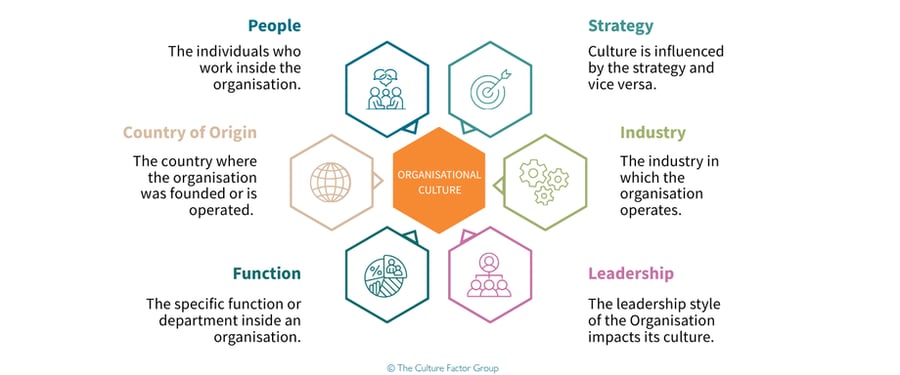
There is no single list of fixed Organisational Culture types. Culture exists on a spectrum, shaped by strategy, industry, leadership, function, country of origin, the people within the organisation, and many other factors.
To make this more tangible, however, below are a few examples of how culture may appear in different industries.
For the sake of privacy, none of the examples below represent real organisations. Instead, they are examples built from broad industry patterns observed in the entirety of our Organisational Culture data. They are not exact industry averages, but rather illustrative examples designed to show what culture can look like in practice.
The dimensional scores shown in the examples (D1-D6) refer to the six dimensions of The Multi-Focus Model on Organisational Culture, our framework for measuring and comparing how organisations work in practice.

Construction Industry Culture
The construction industry typically operates with tight timelines, strict safety requirements, and localised operations. As a result, companies in this sector tend to favour structure over flexibility and clear hierarchies over informality. The culture is practical, execution-focused, and often resistant to change, especially when things don’t go according to plan.
This shows up in the Organisational Culture dimensions as:
-
Goal-oriented (D1 ~65): Success is measured by timely delivery and staying within scope. There’s a strong emphasis on hitting defined project targets.
-
Externally driven (D2 ~60): Companies adapt to client needs and regulations, though often through a lens of practicality.
-
Tightly controlled (D3 ~60): Rigorous control supports safety and compliance, but can reduce agility, making it harder to adapt when delays or disruptions occur.
-
Professionally focused (D4 ~70): Employees tend to identify strongly with their trade, technical expertise, and professional role. The industry typically consists of larger industrialised players with lots of smaller subcontractors whose culture is more built around personal loyalty.
-
High approachability (D5 ~25): Leadership tends to be approachable.
-
Progressive management (D6 ~30): Given the constantly shifting economic landscape of the construction industry, progressive management is essential. Leaders must adapt by considering and accounting for employee availability.
In short: Construction culture emphasizes control, reliability, and successful delivery. Crucially, it must also retain the adaptability needed to navigate shifting economic landscapes.

Health Care & Social Assistance Culture
The culture in healthcare and social assistance is shaped by a strong sense of duty, procedural rigour, and emotional resilience. With lives and well-being at stake, the environment tends to prioritise results, control, and structure, particularly in clinical settings like hospitals.
While these two sectors are often grouped together, it’s worth noting that hospital culture is its own world, typically more high-pressure and hierarchical than many areas of social assistance, which may allow for more flexibility or relational focus.
Here’s how this culture shows up across dimensions:
-
Highly goal-oriented (D1 ~70): A laser focus on delivering outcomes: health, safety, and care standards, but within a heavily regulated profession.
-
Moderately internally driven (D2 ~45): Ethics and professional standards often guide action more than patient or client demands.
-
Controlled environment (D3 ~60): Clear protocols support safety and consistency, though they can limit adaptability.
-
Moderately professionally focused (D4 ~60): Employees often identify strongly with their professional role - such as clinician, nurse, therapist, or specialist - while still maintaining attachment to their institution or care team.
-
High approachability (D5 ~30): Open communication - especially across roles - is necessary as people move throughout the system, and stakeholders across many fields need to work together.
-
Balanced management style (D6 ~50): Leadership approaches vary, mixing traditional authority with emerging collaborative models.
In short: A mission-focused, structured culture that delivers under pressure, but often at the cost of openness and agility.

Educational Services Culture
Educational institutions tend to operate with a mix of structure, autonomy, tradition, and purpose. Their culture reflects this balance: not overly rigid, not especially informal, just solidly in the middle. It’s not the most extreme in any one direction, but that’s what makes it so useful for understanding how cultures can differ.
In fact, across all industries globally, educational services come closest to a "middle line," offering an interesting reference point when comparing other sectors.
Here’s how that balance shows up:
-
Goal orientation (D1 ~60): There's a clear focus on outcomes, learning objectives, and performance standards, but not to the level seen in sectors like production.
-
Customer orientation (D2 ~50): A balance between meeting student needs and upholding academic or institutional values.
-
Level of control (D3 ~55): Procedures and policies ensure consistency, but with room for professional autonomy in classrooms and curricula.
-
Moderately professionally focused (D4 ~60): Teachers, lecturers, and academic staff often identify strongly with their professional expertise and discipline, more so than with their institution.
-
Moderate Approachability (D5 ~35): Hierarchies are typically flat, and teachers and staff alike need to have a free flow of information to assist students.
-
Management style (D6 ~45): Leadership often skews towards traditional, more hierarchical leadership, but with increasing movement toward shared decision-making in some environments.
In short: Educational services reflect a pragmatic, balanced culture. It is structured without being rigid, and purposeful without being performance-obsessed. It’s a useful benchmark for understanding how other industries diverge from the "norm."

A Culture Leadership Teams Aim For (Mining Sector Example)
So far, we've looked at cultures as they are, but what about the culture leaders want to create?
In many organisations, management teams have a clear vision of the kind of culture they believe would best support their goals. It’s not always the culture they currently have, but it reflects what they think would help the company succeed.
When we look at mining companies as a whole, a common pattern emerges in the kind of culture leaders aim for:
-
Clearer goals (D1 ~65): Leaders want teams to be more focused on delivering results, not just following routines.
-
Greater customer responsiveness (D2 ~60): A shift toward listening more actively to clients, regulators, and external partners.
-
Structured but not rigid (D3 ~55): A desire for control where it counts (especially around safety), but with some flexibility built in.
-
Strong Professional focus (D4 ~75): This stands out. Leadership often seeks a culture where professional competence, specialist expertise, and occupational identity play a larger role in shaping how work gets done.
-
Moderate Approachability (D5 ~35): A fairly open system. Leadership would want everyone to feel welcome, informed, and people to speak up.
-
Mildly traditional leadership (D6 ~40): Leaning towards employee oriented, where peoples' personal problems would be taken into account, but not so far that they would compromise completing the job.
In short: This is a culture designed to be focused, responsive, and professional, while maintaining a clear structure and leadership clarity.
Interestingly, this also shows how culture isn’t static. Across industries, we often see a significant gap between the current culture and what leadership wants it to be. For example, the strong preference for a more professional focus (D4) contrasts with the much lower scores we often find in practice. In fact, our global research shows D4 is one of the dimensions where managers and employees most often disagree: while both parties want a professional culture, the managers tend to emphasise this a noticeably higher compared to their employees.
This kind of example helps illustrate what Organisational Culture is really about: not buzzwords or values on posters, but the practical ways people work, decide, and interact, and how that aligns (or doesn’t) with the direction the organisation is trying to go.
Final Thoughts
As we have seen throughout this article, there is no single Organisational Culture that guarantees success. Different industries, strategies, and operating environments require different cultural strengths. What works exceptionally well in one organisation may be entirely unsuitable in another.
The key is not to pursue a culture that is generally considered successful, nor to imitate the culture of well-known organisations. The goal is to develop an Organisational Culture that supports your organisation’s strategy, operating context, and long-term objectives.
This is what makes Organisational Culture such an important strategic consideration. It shapes how decisions are made, how people collaborate, how leadership is experienced, how organisations respond to change, and ultimately how effectively strategy is executed.
Understanding the different kinds of Organisational Culture is therefore not simply an academic exercise. It is a practical way to better understand how your organisation works today, and whether those ways of working are helping or hindering your goals.
For many organisations, that is where the most valuable questions begin:
-
What kind of culture do we currently have?
-
How well does it support our strategy?
-
Where are the gaps between how we work today and how we need to work tomorrow?
Answering these questions requires more than assumptions or perceptions. It requires careful analysis, meaningful dialogue, and often objective measurement.
If you would like to explore your organisation’s culture in greater depth, contact us to discuss how The Culture Factor Group can help you better understand the culture you have, and shape the culture you need.